
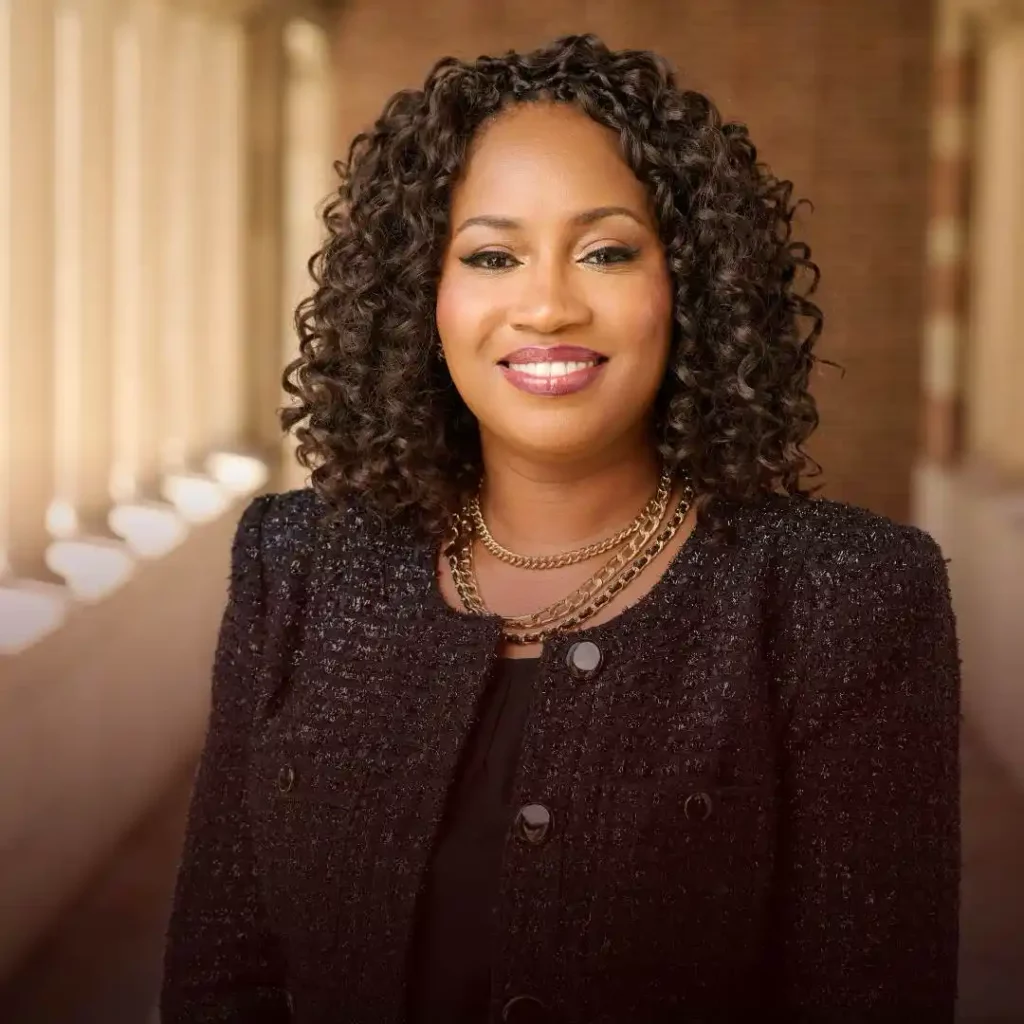





Borders, for Ivon Bensason (LLM 2009), have always been things you traverse, not barriers to entry.
She speaks three languages fluently: Turkish, French and English.
She was born in Israel and grew up in Istanbul, attending a French lycée. She learned international law in French, but completed her Master of Laws (LLM) degree in English at USC Gould School of Law. Today, she lives in Astana, Kazakhstan, with her husband, a French diplomat, and their young Turkish-born son. Every three weeks, Bensason makes a five-hour air-commute to work in Istanbul.
Integrating culture and the virtual world
The 44-year-old USC Gould alumna is founding co-director of KARMA XR Lab, based out of Koç University, where Bensason wears a second hat as research project director under the vice president for research and innovation.
Established in 2019, KARMA Lab brings together designers, narrative artists, extended reality (XR) developers, psychologists, neuroscientists, engineers and computer scientists who create transformative experiences related to education, health, cultural heritage and industry.
Bensason and her team are currently laser focused on Heriforge, a €5 million EU-funded initiative to seed a network of innovation hubs in Poland, Cyprus and Turkey bringing together cultural heritage and XR. Also at full throttle is a KARMA Lab-led XR digitization push to preserve and mediate cultural heritage sites, collections and “intangibles” by creating elaborate digital twins that can function as immersive virtual environments. The latter project is funded by Vehbi Koç Foundation Research Fund, one of Turkey’s premier private philanthropies.
Projects like these advance a grand vision: the preservation and democratization of “culture” itself.
“If we succeed in integrating the cultural heritage of humanity with virtual worlds, it will be a game changer,” Bensason says. No longer will culture be reserved for the privileged.
Past KARMA Lab projects have also investigated how virtual reality can be harnessed to reduce leadership anxiety, and how “co-creation” and “participatory design” can amplify the impact of a “circular economy,” which keeps resources in use and minimizes waste. Bensason and her colleagues have authored several scholarly papers on the citizen-science aspect of this economic model.
To be clear, Bensason is no economist. Nor is she a virtual world builder. She likens her role as KARMA Lab’s co-director to that of an executive producer on a film project: “I’m the one who builds and executes the strategy, finds the budget, understands the needs of contributors and ensures everything works together.”
Before launching a state-of-the-art university research lab, she practiced IP law for more than a decade in Istanbul, representing the kind of creative talent she’d first encountered in Hollywood during her time at USC Gould.
Indeed, Bensason considers her USC Gould education “the golden key that can unlock any door.” As KARMA Lab’s chief executive, she still leans into her legal training “70 or 80 percent of the time” on any given day.
An international upbringing
 Bensason’s boundary-blurring story begins in Tel Aviv. Her mother and father were born and raised in Istanbul with Sephardic origins dating back to the 15th century expulsion of Jews from the Iberian Peninsula during the Reconquista. Her parents immigrated to Israel in the early 1960s, escaping civil turmoil in Turkey for the promise of better higher education opportunities and a peaceful life. After 20 years, worn down by war and instability in Israel, they returned to Istanbul when Ivon was 7.
It was 1989, and Turkey was opening to new markets and privatization. Bensason’s father found success upscaling his family’s hat-making business into a wholesale menswear company. Her mother tapped into a booming travel industry as a professional tour guide fluent in five languages, including Spanish and Japanese.
Home was warm but complicated. Bensason’s parents amicably divorced when she was 10, and each remarried, creating two blended families of four kids. Today, Bensason and her siblings are spread across Turkey, Canada, the United States, and Kazakhstan.
Even as a child, Bensason had a keen sense of justice and a habit of speaking up when something seemed unfair. She was schooled in French — following a longstanding tradition among Istanbul’s non-Muslim minorities to send their offspring to foreign mission schools. Bensason went on to study law at Galatasaray University, an elite francophone institution rooted in the Ottoman palace school system through its lycée. Her bachelor’s program covered European Union law, the continental tradition, and the Turkish system. Wanting to expand her horizons to Anglo-American jurisprudence and legal systems, she applied to USC Gould.
As an LLM student, she was free to enroll in any course offered to JD students. Entertainment law drew her in from day-one, and she signed up for every IP-related course offering that year.
“It’s like a puzzle: getting many artists to create together,” she says. “You need to organize the collaboration fairly, recognizing and valuing each contributor’s interests, in order to get this amazing content.”
Bensason found herself learning from top entertainment attorneys who were on-the-ground players in major Hollywood deals.
“They came at you with information that would otherwise take years to grasp,” she says.
The Trojan Network was an unforeseen boon. Doors flew open wherever Bensason knocked. “Once you become a Trojan,” she says, “everybody takes your calls. They’d just ask: ‘What can we do for you?’”
One Trojan connection that deeply impacted Bensason’s career came from outside USC Gould. After finishing her LLM degree in 2009, she accepted a job with the Los Angeles-based legal affairs department of the Turkish Film Council. When Turkey’s Ministry of Culture wanted to meet leaders of the world-famous USC School of Cinematic Arts, Bensason easily connected the delegation with Elizabeth Daley, the school’s longtime dean. What emerged from that meeting was a framework for international collaboration between USC and the Turkish film education sector.
For Bensason, the collaboration provided a glimpse inside the academy. Working alongside Daley and associate dean for international projects Alan Baker, “that project became my entry into research and innovation.” she says.
An inspiring visit
Bensason moved back to Istanbul after two years. The city on the Bosphorus was then experiencing a creative boom, having been named a European Capital of Culture in 2010. Film and documentary projects poured in, and Bensason started her own IP law firm. She spent a decade in entertainment litigation, managing agreements between Turkish producers and international media companies.
But in 2021, she decided to wind down her practice.
By then she was married, and her husband’s diplomatic career demanded mobility, so Bensason pivoted to the academy.
The idea for building KARMA Lab grew out a 2016 trip back to LA. She would always check in with the USC cinematic arts dean on such visits. That year, Daley invited Bensason to tour the Institute for Creative Technologies (ICT) — a U.S. Department of Defense-funded research hub pulling together USC’s multidisciplinary strengths in digital filmmaking, game design, engineering and new media. There, Bensason met with institute director Albert “Skip” Rizzo — a clinical psychologist who was then pioneering the emerging field of medical virtual reality.
She strapped on a VR headset for the first time and was blown away.
Back home in Istanbul, she set about building the Turkish equivalent of ICT. She pitched the concept to Koç University, a respected institution with a medical school, engineering, computer science and social sciences all under one roof: “everything you need to play nicely with this space,” she says.
Together with Asim Evren Yantaç, a design, media and visual arts professor at Koç, Bensason launched KARMA Lab in 2019 with a grant from the Istanbul Development Agency. The project has since grown to about 20 active researchers and staffers.
A border-crossing future
Currently, Bensason’s home is in Astana, Kazakhstan. She met her husband, Sébastien de Courtois, in 2013, through a circle of French-speaking friends in Istanbul. An attorney and cultural historian by training, de Courtois was then a foreign correspondent writing for Le Figaro and other Paris journals. Today, he is counsellor for co-operation and cultural affairs at the French embassy in Kazakhstan. He and Bensason have been married 10 years, and they have a 5-year-old son, Constantin.
Before his current posting in Astana, de Courtois’ diplomatic career took the family from Ankara to Nicosia, where he was cultural attaché between 2021 and 2025.
Bensason only spends a week of each month in Istanbul. The rest of the time, she works remotely from wherever home is. (“I collect a lot of air miles,” she quips, referring to her 3,000 mile weekly commute from Astana.)
Post-pandemic acceptance of remote work, she says, has made the balancing act possible. In her down time, Bensason swims — long, solitary distances in the sea, a couple of kilometers at a stretch.
Though Bensason is now based in Kazakhstan, the trips to Cyprus continue. Last year, she began an executive-PhD program in science and technology in archaeology and cultural heritage at the Cyprus Institute. Encouraged by French physicist and heritage scientist Michel Menu, Bensason began to situate her intellectual practice more firmly in that space.
Ten years from now, she pictures herself leading a cultural heritage foundation embracing immersive technologies. It could be in Turkey. Or France. Or someplace she’s never set foot.
Her advice to international IP attorneys looking to follow her border-free path: “Be useful, curious, open. Above all, be humble. The degree matters, but it’s only the beginning.”


 Previous Article