










Racial Inequality Has Become Self-Reinforcing
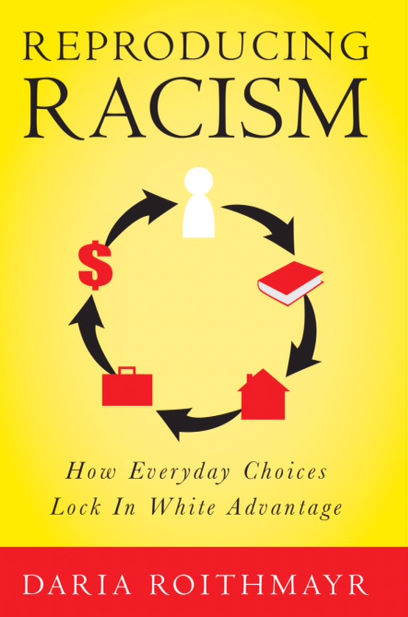
“Reproducing Racism: How Everyday Choices Lock in White Advantage” by USC Gould School of Law Professor Daria Roithmayr
Five years after the inauguration of the first black president, racial inequality lives on, reproducing itself in a vicious cycle. Even if all discrimination were to end tomorrow, self-reinforcing racial disparities would continue, according to the new book “Reproducing Racism: How Everyday Choices Lock in White Advantage,” by USC Gould School of Law Professor Daria Roithmayr.
|
.jpg)
Roithmayr’s book focuses on racial gaps in housing, education and jobs—for example, Latino and black poverty rates are between 2.5 and four times the rate for whites, and black unemployment is double that of whites. Drawing on work in social network theory and other disciplines, Roithmayr argues that everyday choices recreate these racial gaps from one generation to the next.
“It’s really a racial ‘rich get richer’ story,” Roithmayr says. “It’s all about the power of networks.”
For example, whites in well-paid jobs refer their friends for jobs, who in turn refer their friends and so on. White networks have more high-paid jobs; black and brown network contacts are more likely to be under- or unemployed. Likewise, affluent white neighborhoods finance their schools with their property taxes, providing students with richer learning experiences and opportunities. Those graduates go on to live in the same or equally affluent neighborhoods.
“It turns out that racial inequality persists because the old clichés are true: it does take money to make money, and it really isn’t what you know but who you know. Because racial disparities now run on automatic pilot, these gaps will continue even in the absence of intentional discrimination,” Roithmayr says.
Will affirmative action programs or an increase in school funding help to dismantle this cumulative inequality?
Unfortunately not, says Roithmayr. “Small reforms won’t help. I think racial inequality is probably locked in structurally at this point. Unless policymakers immediately take drastic steps, like rethinking how we finance public schools, pass along jobs or give our kids financial assistance when they’re starting out, these feedback loops will continue to reinforce existing racial gaps.”
 |
Roithmayr suggests broader scale restructuring. One idea she favors is baby bonds—a program that gives babies from low-wealth families a sum of money that they can access for houses or education when they come of age, to recreate the kind of head start that family wealth gives whites. Another idea is to encourage workplaces that are predominantly white to use digital networks that include people of color, at least until the workplace is sufficiently diverse. “Fifty percent of all jobs are filled by word of mouth,” says Roithmayr. “We have to create opportunities for white workplaces to hire using networks that aren’t all white.”
Without structural change, racial disparity will persist, Roithmayr says. “We have to change how we think about race. We will make no real progress as long as racial inequality keeps reproducing itself automatically.”


 Previous Article