








.jpg) |
| Wood joined law and political science scholars and experts on campaign finance laws to testify about the effects of “dark money” in the federal judiciary. |
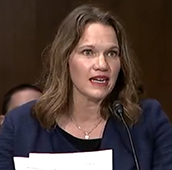
Abby Wood, professor of law, political science and public policy at the USC Gould School of Law, was asked to provide expert testimony on transparency and accountability in the courts before the U.S. Senate Committee on the Judiciary – Subcommittee on Federal Courts, Oversight, Agency Action and Federal Rights. The hearing took place May 3 in Washington, D.C.
Wood was invited to testify about the effects of “dark money” – political spending from groups that do not disclose the identity of donors – in the federal judiciary, and whether this practice erodes trust in the courts. She joined a panel of four other law and political science scholars and experts on campaign finance laws.
Wood, well known for her research on campaign financing and administrative law, emphasized three points in her testimony: how disclosures affect decision-making and why sources of amicus briefs should be disclosed; that claims that disclosure discourages free speech are disproportionate to any “chilling” of speech that actually occurs; and that dark money chips away at political trust.
“Well-designed disclosures can help us decide how to vote, what to buy, where to eat, which doctors and financial advisors to trust, and yes, which judges and justices and amici to trust as well,” Wood said.
Asked by committee Chairman Sen. Sheldon Whitehouse to explain why amicus disclosure is important, Wood noted that anonymous amici allow parties to get around page limits for briefs and slip in supplementary arguments, defeating the adversarial aspect of the legal system. Circling back to a previous argument that decision-making depends on knowledge about sources, Wood said disclosures can make the difference between justices reading or setting aside an amicus brief.
“We already know from something that Justice Ginsburg said a while back, that they put them in three piles – ‘don’t read, maybe read, definitely read,’” she said. The financial “source of the actual argument that comes before the court via an amicus might affect which pile it goes in. I think [disclosure is] really crucial.”
In written testimony, Wood referred to her 2015 survey of 2,000 adults of voting age about campaign features including disclosures of funding sources and support from outside groups, among other things. Campaign finance disclosure emerged as a top concern among these voters, she said.
“It’s important to understand the phases of how dark money is involved in our judicial process, even if not all of it can be regulated successfully,” said Wood, reflecting later on her testimony. She noted how dark money groups are a significant part of the vetting process, and explained that these groups also “spend a lot of money in support of, or opposing, the nominees during the confirmation process.”
Wood added, “they are involved both as parties before the court and as amici, or friends of the court. To make matters more complicated, sometimes the amicus writers have financial support from dark money sources – some of which might be parties in the same case or might support the parties of the case.”
The day before the hearing, a draft decision from the U.S. Supreme Court that would overturn Roe v. Wade was leaked and took center stage in national discourse.
Wood was asked by ranking member Sen. John Kennedy for her opinion on how the leak affects the legitimacy of SCOTUS.
“I think that the substance of the leak, which shows that the court is going against the majority of the country, is much more damaging to the legitimacy than the leak itself,” Wood said.


 Previous Article