







Lecture addresses the state of capital punishment
-By Sheila Grady
In contemporary judicial and political debate, few issues elicit such impassioned deliberations as capital punishment—the topic featured in the latest installment of the Justice Lester W. Roth Lecture series.
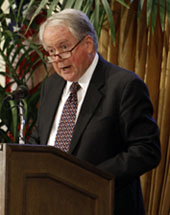 |
| Judge William A. Fletcher |
In his Nov. 9 lecture – “The Death Penalty: Where Are We Now?”— the Honorable William A. Fletcher outlined the complex history of capital punishment for a captivated audience of students, faculty and members of the USC Law community.
Drawing on his professional experiences as both judge for the United States Court of Appeals for the Ninth Circuit and former professor of Federal Courts and Jurisdiction and Civil Procedure at the University of California, Berkeley, Boalt Hall School of Law, Fletcher gave a chronology of Supreme Court cases dealing with the death penalty, giving the audience a sense of historical and cultural context.
“I intend to explain where have we been, where we are now, and where we go from here,” Fletcher said.
Before delving into his analysis of specific regional and state tendencies regarding capital punishment, Fletcher reminded the audience of the uniqueness of the United States’ position on this issue.
“The U.S. is unusual among industrialized nations in retaining the death penalty — a distinction that is shared only with Japan and South Korea,” he said. “Most of Europe had already renounced it before it was officially abolished by the European Convention on Human Rights in 2002.”
The lecture itself was filled with an array of surprising facts, which Fletcher employed to expose the cultural biases at work in influencing public opinion. He addressed the role of poverty and race as undeniable factors in shaping disproportionate percentages of minorities represented on death row, but he also described regional differences in acceptance of capital punishment. 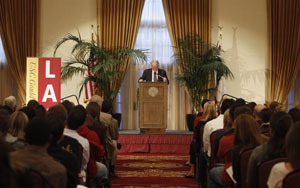
“While public approval is now around 65% nationally, this varies regionally,” Fletcher explained. “Surprisingly, the South least favors the death penalty but has the most public executions.”
One of the more unexpected truths about the death penalty, Fletcher said, is that contrary to public opinion, a sentence of capital punishment is far more expensive to taxpayers than a sentence of life in prison.
“The death penalty is extremely expensive and extremely slow,” he said. “It’s far more expensive to house someone on death row than in the general prison population. Since there are usually 20 years between a conviction and administration of punishment, the legal fees alone run into the millions.”
As the lecture came to a close, Fletcher highlighted one of his greatest concerns about the continued use of capital punishment: the conviction and execution of the innocent.
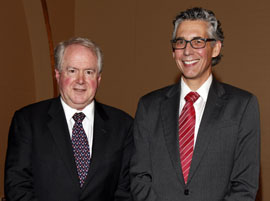 |
| Fletcher & USC Law Dean Robert K. Rasmussen |
After profiling a number of West Coast examples in which — in his opinion — someone was wrongly put to death, Fletcher impressed upon the audience the necessity of professional discretion of all parties involved in capital punishment cases. Police, prosecutors, courts, and governors must uphold their positions with the utmost regard to the law, he explained.
Fletcher chronicled multiple Supreme Court cases, shifts in public opinion, and continued political debate regarding the death penalty, and acknowledged it is unrealistic for the average citizen to know all of the history behind current capital punishment practices.
Yet, he said he hopes that if average citizens come to know the facts, they might consider implementation of the death penalty more carefully.
“Perhaps we as a country will have eventually seen enough,” he said.

 Previous Article