






Five USC Gould students reflect upon the time their families spent interned in camps during WWII
On Feb. 19, 1942 President Franklin Delano Roosevelt signed “Executive Order 9066,” which paved the way for the forced removal and incarceration of 120,000 Japanese-Americans from the West Coast during World War II.
Families were forced to leave their homes and businesses and move inland to camps, sometimes thousands of miles from home. Many families were not allowed to return to their homes for years. The same Order led to one of the most infamous cases in the history of the United States Supreme Court, Korematsu v. United States, 323 U.S. 214 (1944).

|
“This historical event reminds us of the incredible power of law and the critical ways in which it affects both individuals and our society,” stated USC Gould Dean Andrew Guzman. “To some members of our community, however, these events are also personal. Members of our community and their families were affected by Japanese internment during the war.”
Five of our own students (Cynthia Chiu ’19, Stephanie Howell ’18, Mike Mikawa ’17, Kenneth Oshita ’17 and Monica Parra ’19) have graciously shared their family’s stories with us as we approach the 75th anniversary of EO 9066.
Some of them shared that their family’s experience helped to fuel their passion for public service, civil rights as well as their pursuit of a career in law. Cynthia Chiu ’19 wrote: “I think that lawyers are in a position of power to make a difference and to stand up for others.”
Excerpted below are their stories. This spring, the Asian Pacific Law Student Association (APALSA) is commemorating these experiences by collecting additional stories. If you would like to participate you are invited to send your story to [email protected].
How was your family affected by EO 9066 (who in your family was interned)?

|
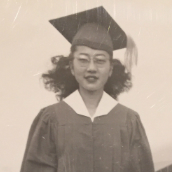
| Cynthia Chiu '19's high school-age grandmother, photographed at the internment camp in Jerome, Arkansas |
Mike Mikawa ’17: My family was incarcerated at the Poston Concentration Camp in Arizona and the Tule Lake Segregation Center in northern California.
Before camp, my maternal family farmed strawberries in Watsonville, Calif. and my paternal family ran a general store in Penryn, Calif. Both lived in small “Japantowns” due to segregation and prejudice. Before being sent to camp, my grandparents and their families were forced to live in the Salinas Assembly Center and the Marysville Assembly Center, respectively. These were often former work camps or fairgrounds where internees were forced to live in horse stalls and barns.
Stephanie Howell ’18: My grandfather, who was originally from the Seattle area, was interned in Heart Mountain in Wyoming. His parents and siblings were interned in Heart Mountain, Minidoka (Idaho), and Tule Lake. Many of his nieces and nephews—my mother’s cousins—were also interned, including one nephew who was born in Minidoka
Kenneth Oshita ’17: All of my grandparents were Nisei (2nd generation) Japanese-Americans and were interned during the war. My mother’s parents were interned at Manzanar (Calif.). My father’s parents were interned at Heart Mountain. I believe they were all in their twenties at the time.
Monica Parra ‘19: My grandfather, a U.S. citizen born in San Francisco, was interned at Manzanar.
What are some stories you recall hearing during your childhood about your family’s internment camp or WWII-era experiences?
Chiu: My grandmother talked about how her brother became very sick and had to be transported to a hospital outside the camp. Her mother never forgave the U.S. government when he passed away without letting any of the family members see him.
She also recalls being told that she could only bring two suitcases with her and that they had 48 hours to leave their homes, not knowing how long they would be gone. They were sent to an assembly center, which was a renovated horse track. She recalled sleeping in horse stables with several other families until the camps were finished being built. She was sent on a train with the windows blacked out, not knowing where they were heading.
Mikawa: My maternal grandmother was incarcerated as a teenager in the Poston Concentration Camp with her family. Poston was nicknamed “Toastin’ Poston” due to the desert heat and sandstorms that beat down on the internees
Her step-father was a first-generation, and as a Japanese national was ineligible to become a naturalized American citizen due to the Naturalization Act of 1790. In camp, he became a “No-No Boy” because he answered no to both question 27 and 28 of the infamous loyalty questionnaire.
As a Japanese citizen unable to naturalize, he felt answering “yes,” would leave him without a country. No No Boys
were branded as traitors and disloyal. The U.S. Government transferred him along with my grandmother’s entire family to the Tule Lake Segregation Center. Tule Lake became a high-security prison for troublemakers. Tule Lake had its own holding cells within the camp. After the war, my grandmother and her family moved to Japan as a result of being imprisoned by their own country. However, war-torn Japan was inhospitable and they eventually returned to California.

|
| Mike Mikawa '17 and his grandparents |
My maternal grandfather was also incarcerated in the Poston Concentration Camp. Due to a labor shortage, my grandfather was allowed to leave camp to pick sugar beets in Idaho. Around 1943, he was released from camp. However, soon after he was released, the U.S. Army drafted him. He joined the 442nd Regimental Combat Unit, which received the Congressional Gold Medal in 2011. The 442nd was the segregated, Japanese American unit. It received more medals than any other unit of its size in American history. He served his tour of duty in Germany. After the war, he returned to Watsonville and farmed strawberries for 50 years. When asked about camp, he replied with “Shikata ga nai,” which means, “It cannot be helped.” He saw it as an injustice, but he felt helpless to do anything. He grew up in a poor family in farming country. His parents were immigrants who were ineligible to become American citizens. They had few rights. His parents could not even own land. (See "California Alien Land Law,” which was successfully challenged in 1952 by two USC Gould alumni, Sei Fujii JD 1911 and J. Marion Wright JD 1912.)
My paternal grandfather was in his early twenties when he entered camp at the Tule Lake Concentration Camp. His father died when he was nine years old and his stepfather died when he was 13. He was the eldest son of eight children. When he received the loyalty questionnaire in camp, he replied “No, No” because he needed to look after his brothers and sister. He did join the U.S. military, but three of his younger brothers later served in the Korean War. My grandfather felt ashamed of camp. He did not like to talk about it. Many of the former internees felt this way. After camp, they were silent about their experiences. They wanted it to fade away.
My paternal grandmother was not incarcerated in an internment camp. She was an American citizen, but her father had sent her to be educated in Japan. When the war began, she was stuck and could not return home. Her father, who was born in Hawaii, was incarcerated at the Tule Lake Concentration Camp. During the war, the Japanese military tried to force her to renounce her American citizenship, but she refused. Unfortunately, her family lived in Hiroshima throughout the war. She is “hibakusha,” which means atomic bomb survivor. She survived her own country’s atomic bomb in Hiroshima. Luckily, she worked in the Mazda factory, a concrete building that was far from the epicenter. After the war, she returned home to California.
Howell: Although my grandmother and her family were not interned, the family still felt the effects of EO 9066 when my great-grandfather was arrested in the early 1940s on suspicion of being a Japanese spy. The police justified the arrest because he owned a camera, a map, and a gun; my great-grandfather owned these items because he liked photography and he needed a map and a gun to monitor his farm in rural eastern Oregon. He was held in jail.
My grandmother, who wanted to become a nurse, was not allowed to attend any nursing school on the West Coast because she was Japanese-American. Eventually, she found a school that would accept her in Chicago.
Oshita: My grandparents didn’t really talk about internment, to their kids or to us grandkids, so I don’t recall many stories. I do remember my maternal grandmother talking about the dust in the barracks, how the sand would come through the slits in the wood floors and get everywhere. I also remember that my maternal grandfather served in the US military, helping with intelligence and translating Japanese communications.

|
| Tule Lake Segregation Center Prison, photo by Mike Mikawa '17 |
Did your families lose any property or businesses? What was it like for them to rebuild once they were released?
Parra: My grandpa was only allowed to take one suitcase into the camp, and therefore lost all his other personal belongings that were left in his abandoned apartment (including family photos, car, valuables, etc.). Once he returned to the states, he became a gardener and did landscaping until he retired.
Chiu: My grandmother's family was renting a house, so they knew that there was no chance they would be able to live there when they returned. They tried to sell as much as they could before they left, but with such little time, they were forced to bury many of their valuables in the backyard hoping it would be there when they returned. My grandma remembers leaving behind her violin and being devastated that someone had dug up their belongings and taken them by the time they returned from camp. My grandma took a bus from Arkansas to Chicago and worked at a factory there before trying to make enough money to come back to California.
Internment was a big reason why my grandparents didn't pursue a higher education and worked at a nursery until
they were in their late seventies. Trying to rebuild a life that they had lost and just trying to make it back to California was what they spent their early and late twenties thinking about, and by the time they did, it was too late to go to college.

|
| Camp Jerome, 1944, as depicted in Cynthia Chiu's grandmother's yearbook |
When they closed Camp Jerome early (1944), they gave all internees $25 when they left. They had to remain east of the Mississippi River or if they wanted to go west, they were told they would have to go to the camp in Gila, Arizona. Grandma went on to Chicago with many of her siblings but her parents went back to Arizona. They were separated for the duration of the war until she made her way back to California.
Oshita: Yes, my family lost all of the land they owned and many of their possessions. They lost friends; they lost their livelihoods; their lives were totally disrupted—how could it not have been? At the end of internment, both my mom’s family and my dad’s family were considered “no-no” families. They answered as “no-nos” on the loyalty survey circulated around camp at the end of the war because their families still had property in Japan, whereas they had nothing back home (in America). So, they were sent to Japan after the war, and, after a few years, my grandparents (who married each other by this point) all came back to the states and settled in Chicago. Racism wasn’t so rampant in the Midwest and my grandparents were able to find work and make a life. There was a strong Japanese-American community growing in Chicago at this time, so they were able to connect to a support system and make it through the difficult time. My parents were both one of six children each (I have a big family!). And, today, two generations out, my family is doing well: I’m in law school and went to a good college; my sister and most of my cousins have graduated from college and are happily married with kids; I have a cousin in her first year of medical residency at Yale; another cousin at Northwestern Law; another cousin a firefighter; a few cousins in the military; and another cousin who is a rap artist that just signed with a major record label. All of our success is truly a testament to the foundation that my grandparents were able to lay here in America.
How did these experiences shape you and your family? Your decision to become a lawyer?
Howell: My grandfather was drafted into the military from Heart Mountain. He did not see action, but he was stationed in Germany for a period of time.
My cousin is currently working on a PhD about Japanese American life in the 1950s with a specific focus on the community surrounding Los Angeles.
My mother did not learn about her parents’ experiences until she left for college. Since many members of the Japanese American community—including my grandparents—did not discuss the war, it was very hard for her to come to terms with their stories. To this day, it is still difficult for her to reflect on that period in our country’s history.
When my sister was born on Pearl Harbor day, my grandmother was incredibly sad that her granddaughter would celebrate her birthday on the anniversary of a day that caused so much pain for her and her family.
For me, especially as a mixed-race person (my father is white), it has been very important to connect with my Japanese American side to reflect on these experiences. I have tried to make an effort to get to know the Japanese American community and learn more about the effects of internment.
Mikawa: My heritage as an American of Japanese descent and the Japanese-American internment experience are essential to my personal identity and my pursuit of becoming a public service attorney. I majored in Asian American
Studies as an undergraduate and have been heavily involved in the Asian Pacific American community.

|
| Mike Mikawa '17 visiting Poston site. |
During my freshman year at UC Berkeley, I made a pilgrimage to Tule Lake. I heard grown men weep as they shared their families’ internment stories. I was shocked by the psychological scars that burned across generations. Suddenly, I understood my grandparents’ silence about their past. I understood my father’s refusal to speak Japanese. I understood how racism made my family ashamed of our heritage.
I also felt gratitude for the previous generations that had persevered through discrimination to give me a chance at a better life. I was living my grandparents’ dreams by attending college. Higher education was a scant option for them while they battled discrimination. As a person with so much opportunity, I felt a responsibility to use that opportunity to help others. The Japanese American community’s legacy of overcoming injustice inspired me to live with a greater purpose towards community, and subsequently forged the beginnings of my public service journey.
Oshita: My grandparents met in camp, yes, and I guess I wouldn’t be here if not for internment. My grandparents each received reparations from the U.S. government, as well, but that wasn’t very important to them. Internment was such a disruptive, tragic time in history, but, to be honest, camp didn’t really seem to have a hugely disruptive and tragic effect on my family. (Calling it “camp” always made it seem like such a normal experience too.)
But internment still affected my family, I think in a very profound way. Internment shaped my family’s identity and our understanding of what it means to be American. My grandparents never taught their children how to speak Japanese, and the few pieces of Japanese culture that were passed down to us have been watered down. My parents said they were taught to say “I’m American!” when asked “What are you?” or “Where are you from?” If they were pressed about it, they’d respond further, “I’m from Chicago,” and if pressed more, “From the Southside.”
My family is happy now, and successful. We’re an “American dream” come true.
But at what cost did assimilation come with? What lesson does my family’s, the Japanese-American, experience teach us? My grandparents were proud to be American. I inherited this from them. I didn’t inherit a distrust of my government. But I question whether my grandparents’ perspective on internment is something to share and memorialize today. I question whether the kind of American-ness that internment taught them to internalize is the kind of American-ness that we, as a country, want to encourage.
Internment was, objectively, a terrible, shameful thing, but, at the same time, I can’t look at internment and feel that violation, even as someone whose family directly experienced it. Were my grandparents wise with how they responded to internment, or are they, am I, are we, victims of something more insidious? When I think of internment, I think of this, of the questions it raises and the deeply-rooted issues it unearths. Has internment affected my family? It has, but exactly how is still something I’m trying to unravel.
Parra: My grandpa was always the type of person who didn't listen to anybody... my mom / aunts / uncles always laughed at his stubbornness, and upon learning about his internment, I can understand why he was that way. He had been deemed a foreigner and a terrorist in his own country, and had no choice but to endure what he knew was inherently wrong. My grandparents only spoke Japanese, but unfortunately, they both died before I was five years old. Although I didn't have the chance to know my grandparents personally, their inability to fight for their rights has influenced my decision to become a lawyer and help those seeking justice.
Chiu: My grandfather had helped build that barracks in Jerome and realized that he did not want to be forced to live
there. Many of my other relatives wanted to go back to Japan, but my grandfather was born in America and saw this as his country. He enlisted to show his patriotism for his country and prove that he was an American. He was sent to Italy with the 442nd Regiment. Both of my grandparents received reparations, but neither of them were ever passionate about social issues or even about sharing their experience. My own mother didn't realize that her parents had been interned until late in high school when she learned about it in school.

|
| Cynthia Chiu's grandfather, who was sent to Italy with the 442nd Regiment. |
It has definitely impacted the way I view the law and the government. I think it has made me an advocate of other people's rights. I look at the airport gatherings after Trump's executive order, and it gives me hope that people are standing up against it, signaling that this will not go as quietly as Japanese internment did.
When you hear public discussion about immigration quotas or bans, what goes through your mind?
Chiu: Never again. In order to stand up for human rights, we must do it even when it does not directly affect us or else these atrocities of the past could happen again. It shocks me that we have not learned the lessons of our past, and it makes me fearful that we could treat another group of people the same way the Japanese were treated when politicians use terror to get people to support an agenda.
Howell: My first thought when I heard about the ban was about my family’s experience and the devastating impact it had on their lives. It is striking to notice more and more similarities between the fear towards Japanese Americans that led to EO 9066 and the fear many people have towards Muslims today.
Mikawa: Today, more than ever, the legacy of Japanese-American internment is vital to our nation. We are grappling with the same issues our nation confronted in the 1940s. This past winter, I visited the Poston Concentration Camp in Arizona. But, although it was a somber place, I left feeling optimistic for our country. I felt optimistic because we have owned our history: Congress and President Reagan apologized for Japanese-American internment in 1988. Today, Americans from coast to coast learn about the injustice of internment in their high school history classes. I believe through awareness, justice will prevail. As a Japanese American, I will continue sharing my family’s story so that their experience of injustice will not be forgotten.
Oshita: Perhaps because of my family’s experience with internment and my own experiences being gay, I’m sensitive to the ways discriminatory abuses of power and social hatred can be internalized. I’m sensitive to the way social “norms” shape a person’s identity and affect people psychologically. Trump’s immigration ban is terrifying not just because it seems to violate our rights, but also because of the unseen effects that such a ban will have on generations to come, whether we see them now or not. It’s terrifying because of the kind of American-ness it teaches us to value. It’s not just those who are targeted by unfair laws whose dignity and humanity are jeopardized; we all suffer in some way.
Parra: They say history repeats itself, and I can't understand why. America was built on the idea that there are freedom and opportunity for all. The hard work and contribution of immigrants to our nation's economy and culture is not something that can be overshadowed by race. As a hapa (a person who is partially of Asian or Pacific Islander descent), I was raised color-blind and never saw ethnicity or race as an indicator of how American or "un-American" someone is. I guess I'm just waiting for the rest of the country to catch up.
Howell: My family’s experience is proof that acting on fear can affect the lives of thousands of innocent people. Restricting people’s liberties because we are afraid does not solve the overarching issues.
I was recently inspired to write my note for my journal about whether Korematsu could be used as precedent for the Trump administration’s actions—particularly in reference to a possible Muslim registry. Because Korematsu was never overturned, I argue that its legacy is dangerous and discuss why it should be overturned now.
As a future attorney, how do you see your role?
Parra: Whether I work in public interest full-time, or work in the private sector with a heavy pro bono emphasis, I know that I will fight for civil rights in some capacity. This executive order has helped me realize that my legal education empowers me to fight for those who cannot fight for themselves and that it is my duty to proactively work to uphold justice and equality in this country.

|
| A photo from Mike Mikawa's 2008 visit to the Manzanar Memorial. |
My role as an attorney, I think, is to use my training to help fix/fight/develop the laws that shape our society. But I also believe that my role is simpler than that as well. Being a lawyer sharpens the intuitive sense we all have for noticing how social constructions affect our lives in ways that are personal and real, rather than abstract and legal. As a lawyer, I need to be there, to voice my thoughts, to participate in discussions, to help give depth and meaning to otherwise confusing and amorphous times.
Howell: I hope to impact others primarily through connecting to other Japanese American attorneys. I also have some background in immigration work due to a previous job as a paralegal, so I would like to utilize those skills if necessary to help with those who are affected by any further government actions.
Any further reflections?
Howell: One of the most striking experiences I had recently was watching a filmed version of George Takei’s “Allegiance”—a Broadway musical about one family’s experience with internment. I had a hard time watching the show because the storyline mirrored what my family experienced in so many ways. For example, the family was interned in Heart Mountain, and the young adults featured were in their early 20’s (the same age as my grandfather when he was in Heart Mountain). While interned, the family encounters many hardships, but also participates in social events and farming; I know my grandfather also participated in both. The main character ends up in the military—just like my grandfather—and one of the characters was a USC law student before he was interned. I would encourage everyone to see Allegiance, but particularly those with family who experienced internment.
Chiu: My mom is so moved that this project is being made and that people still want to remember what happened.
Complete versions of these testimonies will be available later this year. If you would like to participate you are invited to send your story to [email protected].
 Previous Article