USC Gould discussion focused on making Los Angeles a city of “second chances”
By Traude Gomez
Los Angeles Mayor Eric Garcetti made a heartfelt plea at the Higher Education Challenge that took place recently at the Gould School of Law.
“We have the opportunity to make progress on a difficult and important issue facing every big city,” Garcetti said. “Los Angeles is a city of second chances; let’s truly make this the city of second chances and work together to reduce barriers keeping Angelenos with prior criminal justice involvement from accessing higher education.”
 |
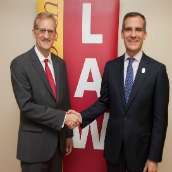
| Dean Andrew Guzman and Mayor Eric Garcetti at the Higher Education Challenge. |
Garcetti said doing so benefits everyone: With one in five Americans now possessing a criminal record and 160,000 people passing through L.A. County Jail each year, individuals with convictions factor significantly in the region’s population. A college education is one of the best insurances against recidivism — only 5.6 percent of formerly incarcerated baccalaureate students and one percent of master’s candidates return to prison. But the issue is also economic: by 2020 two-thirds of jobs in the U.S. will require a college degree.
Mayor Garcetti’s keynote remarks kicked off a greater discussion among six panelists, all distinguished experts within education, who had gathered to examine the impact of policies that prevent or deter the pursuit of higher education by individuals with a criminal past. The hope: attendees would return to their institutions and organizations and work to create a more equitable prison-to-school pipeline.
.jpg) |
| Gould alumna Kimberley Guillemet ’05 moderated and organized the panel. |
Gould alumna Kimberley Guillemet ’05, manager of the Mayor’s Office of Reentry, City of Los Angeles, introduced the speakers and moderated the panel. Her office is tasked with helping formerly incarcerated Angelenos rebuild their lives upon reentry into society, particularly through access to employment and education.
The panelists included Leticia Barajas, vice president of Academic Affairs and Workforce Development, Los Angeles Trade-Technical College; Dr. Nigel Boyle, interim dean of faculty and vice president of Academic Affairs, Pitzer College; Naomi Porterfield Dennis, U.S. Dept. of Education; Steve Good, executive director, Five Keys Charter School; Romarilyn Ralston, activist and research developer, Center for Women in Transition; Rebecca Silbert, Esq., senior vice president, Opportunity and Justice Division, the Opportunity Institute.
The panelists broached a range of related issues, such as whether asking prospective students about their criminal justice involvement on college applications is necessary; productive ways to reach prospective students earlier, when they are still incarcerated; how institutions can work together to make sure that applicants turned away from one institution aren’t lost but are networked into others. Panelists already working with prison populations shared their experiences and urged others within higher education to develop programs that offered real education behind bars.
.jpg) |
| Professor Heidi Rummel led discussion on prison education. |
Following the panel, attendees delved into topics more deeply at three breakout sessions. Heidi Rummel, clinical professor of law and co-director of the law school’s Post-Conviction Justice Project (PCJP), which represents California federal and state inmates in post-conviction issues, facilitated a group that heard viewpoints from ex-inmates who had fought against odds to receive an education in prison. “The problem with prison education is that it’s all correspondence courses and you are isolated even from other prisoners who are taking classes,” said former prisoner Michael Griggs, who heads to Pitzer College in the fall. “There is a complete absence of a classroom experience.”
The overall agreement: Because so many individuals in our communities have prior criminal justice involvement, let’s offer real education in prisons and help ex-inmates access learning and education upon release.











 Previous Article