


Center for Transnational Law and Business hosts panel presentation at World Trade Organization
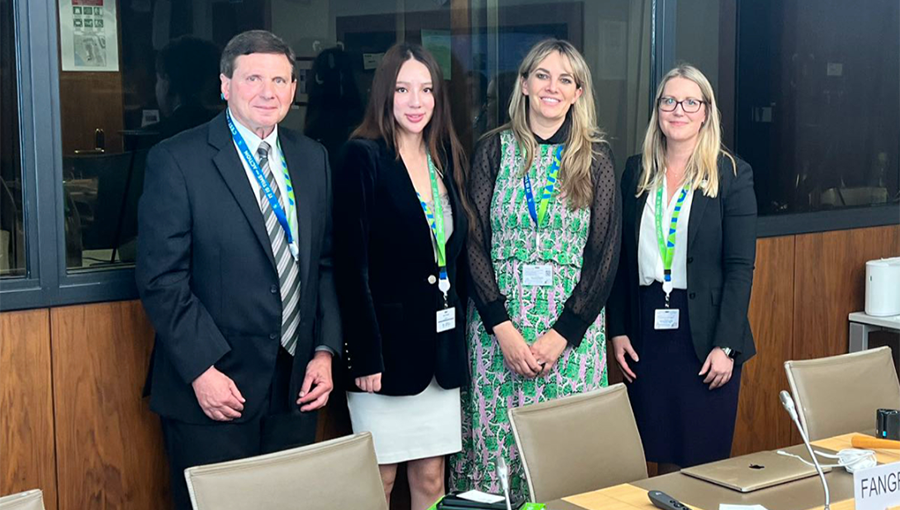
For the third time in recent years, USC Gould’s Center for Transnational Law and Business (CTLB) led a panel discussion at the World Trade Organization’s public forum in Geneva, Switzerland.
The prestigious four-day gathering met in mid-September, bringing together 3,400 international participants and 630 speakers. USC’s panel was one of 134 sessions devoted to the forum’s 2023 green-trade theme, “It’s Time for Action.”
CTLB’s unique niche as one of the few law school-based centers studying regulatory regimes with an impact on cross-border transactions makes it stand out from other organizations applying to host panels at the WTO.
“Major organizations and foreign governments typically host these panels, and we’re a relatively small center out of USC,” says CTLB executive director Brian Peck, whose session focused on creative ways cities and states can accelerate the transition to a global, low-carbon economy.
“WTO members are national governments, so most of the sessions address national-level collaboration or initiatives. We took it in a different direction,” Peck says.
Panelists include CTLB associate director Fangfei Dong, an expert on international trade policy; Christine Peterson, director of international trade and investment in the Office of Los Angeles Mayor Karen Bass; and Emily Desai of the California Governor’s Office of Business and Economic Development.
Subnational advantages in policy-setting
Cities and states can be nimble than nations when implementing sustainable policies, Peck explained in introductory remarks at the session.
“Tensions are obviously increasing in the relationship between Washington and Beijing, but when you get down to the subnational level — for example, the state of California and the Chinese province of Guangdong – there’s more flexibility for collaboration,” he said. A new joint initiative between California and the island province of Hainan to combat climate change illustrates his point.
“Not only can subnational governments play a critical role in helping national governments achieve their greenhouse gas emission targets, but they can also develop and share new technologies and collaborate on utilization of clean tech and clean energy,” Peck noted.
Dong’s presentation focused on the increasing importance of subnational government engagement to advance green trade from a broader global perspective, utilizing specific examples from China. Peterson highlighted the city’s subnational agreements, including green shipping corridors with Singapore, Shanghai, and the Japanese ports of Tokyo, Yokohama and Nagoya.
Desai described California’s latest sustainable trade deals with Canada and Australia. She also presented a best-practices case study of a groundbreaking water-treatment agreement between California and the Mexican state of Baja California.
Peck hopes to keep the USC-WTO connection going and is already drafting a new panel proposal for the 2024 public forum, with the theme, “Inclusive Trade.”
The WTO includes 164 members representing 98 percent of all world trade, and operates a global system of rules designed to ensure that trade flows as smoothly, predictably and freely as possible. The organization settles trade disputes between member nations while supporting the needs of developing countries.
 Previous Article